Sleep is Sacred
Why learning to rest may be one of the greatest gifts we give our future selves.

One thing I've always admired about our dog, Kobe, is how naturally he embraces rest. He doesn't rush through his days or apologize for slowing down. He stretches, curls up in the softest blanket he can find, and sleeps deeply whenever his body asks him to. I can't help but photograph him almost every time I find him this way. Maybe it's because he reminds me of something we all need to remember: nature has always known how to rest. Perhaps we still have something to learn from it.
There is a quiet kind of luxury that cannot be purchased.
It isn't found in expensive vacations, designer handbags, or perfectly curated homes. It doesn't arrive in another product promising to change our lives or another item added to an already full calendar. It lives somewhere much quieter than that.
It waits for us each evening as the sun begins to set, asking only that we slow down enough to receive it.
It is sleep.
Somewhere along the way, we've made sleep feel optional. We wear exhaustion like a badge of honor, celebrate busy schedules, and convince ourselves that staying up just one more hour is somehow productive. We answer one last email, fold one more load of laundry, scroll a little longer, watch one more episode, and promise ourselves we'll catch up on rest tomorrow.
Tomorrow, of course, rarely comes.
Lately, sleep has become something I've been thinking about a lot.
Since turning forty, I've found myself on a quiet mission to better understand the body I'm living in and the ways it will continue to change throughout this next season of life. Instead of fearing those changes, I've been asking myself a different question:
What can I do today that my eighty-year-old self will thank me for?
I'll admit, there are days when those Instagram reels reminding me that I've potentially lived half of my life stop me in my tracks. It's a sobering thought. But rather than looking at it through the lens of loss, I'm trying to see it as an invitation.
What if half my life isn't over?
What if half my life is still waiting for me?
If that's true, then these next decades deserve my attention now more than ever. They deserve a body that has been cared for, a mind that has been nourished, and a soul that has been given permission to rest.
I've also started paying closer attention to the people I love. I notice how they're aging, the diseases that have found their way into our family, the aches that limit movement, and the chronic exhaustion that has become accepted as "just getting older." It has made me wonder how much of our future is written for us—and how much we can gently influence by the choices we make today.
Because the truth is, I don't just want to live a long life.
I want to live a full one.
I want to walk beside Grayson long after he's grown. I want to travel with him as an adult. I want to be the grandmother who chases grandchildren through the backyard, kneels down to admire flowers with them, sits on the floor building blanket forts, and still has the strength to get back up again.
Those dreams don't begin when I'm seventy or eighty.
They begin today.
That realization has changed the way I think about wellness.
For years, so much of the conversation has centered around eating healthier, exercising more, taking the right supplements, or finding the perfect skincare routine. Those things matter. They absolutely do.
But lately I've become convinced that they all rest upon one very important foundation.
Sleep.
Because no matter how many nourishing meals we prepare, how many supplements line our kitchen counter, or how faithfully we make it to the gym, if we're consistently running on poor-quality sleep, our bodies never truly have the opportunity to recover from any of it.
Everything begins there.
Ironically, just as I've begun placing more importance on sleep, it has become harder to find.
As I find myself entering perimenopause, I've experienced a new relationship with bedtime. Sometimes anxiety quietly arrives the moment my head meets the pillow. Other nights, I'm awake at three in the morning, overheated, staring at the ceiling while the rest of the house sleeps peacefully around me. I remember a season of life when falling asleep felt effortless—before motherhood, before hormones began shifting beneath the surface, before life simply became... louder.
I miss looking forward to bedtime.
I miss trusting that sleep would come.
And I suppose I can't talk honestly about my relationship with sleep without talking about motherhood.
Sleep When You’re a Mother
For the past four years, since having Grayson, sleep has been something I've had to learn to live without—or at least with much less of than I was accustomed to. In those early newborn days, good sleep felt almost impossible to come by. My husband and I walked around feeling like literal zombies, piecing together tiny stretches of sleep whenever we could get them. And I don't think I fully understood until I experienced it myself just how deeply sleep deprivation can affect you.
Our brains felt foggy. Our moods suffered. Our patience was thinner. Even our bodies and overall health felt different.
We were completely and utterly exhausted.
Eventually, Grayson began sleeping for longer stretches through the night, and slowly, things got better. We started getting more than a couple of consecutive hours of sleep, and I remember how life-changing that felt.
But now, at four years old, sleep looks different again.
Bedtime in our house can sometimes feel like an entire evening event. We start by turning off the screens and trying to signal that it's time to wind down. Then come the pajamas, brushing teeth, reading books, quiet play, and the seemingly endless negotiations that come with having a four-year-old who has absolutely no interest in ending his day.
Sometimes I feel like I've been singing for an hour straight, rubbing his back, answering one more question, fulfilling one more request, and explaining for what feels like the hundredth time that, yes, it really is time to go to sleep.
By the time he's finally tucked into bed and actually asleep, it can be ten or ten-thirty at night.
And this is where I have to admit that I'm often my own worst enemy. There is also the mom guilt that inevitably creeps in when I find myself wanting to rush through bedtime or wishing, just for a moment, that the whole process could be a little easier. Somewhere in the back of my mind, I can almost hear my eighty-year-old self whispering to me to slow down, to be present, and to soak it all in. She knows what I can't fully understand yet—that these nights of bedtime stories, back rubs, endless songs, and requests for just one more hug will be gone in what feels like an instant. And forty years from now, I have a feeling I would give almost anything to step back into this exact moment—to tuck my little boy into bed one more time, sing one more song, and feel his small body curled up beside mine.
But even knowing that, and even with the mom guilt that sometimes follows, I can still admit that by the end of the day, I am tired. After working, mothering, running a business, tending to a home, and pouring so much of myself into the people I love, those quiet hours after Grayson finally falls asleep feel incredibly precious. For the first time all day, the house is still, no one needs anything from me, and I have a little piece of time that feels entirely my own.
I don't want to go to bed.
I want to watch a show. I want to read. I want to write. I want to create something. Sometimes I simply want to sit in the silence and feel like I have a little piece of the day that belongs only to me.
So I stay awake.
One hour becomes two, and before I know it, I'm finally climbing into bed at one or two in the morning—only to wake up the next day exhausted and promise myself that tonight I'll go to bed earlier.
I recently learned there is actually a name for this: revenge bedtime procrastination—when we delay going to sleep in an attempt to reclaim personal time we didn't feel we had during the day.
And honestly, I understand it completely.
As mothers, I think we spend so much of our days giving. We give our time, our attention, our bodies, our energy, our patience, and our care. When the house finally becomes quiet at night, it's tempting to hold onto those precious hours because they feel like the only ones that truly belong to us.
But I'm beginning to realize that stealing those hours from sleep isn't really giving me more time.
It's borrowing it from tomorrow.
The version of me who stays awake until two in the morning may get a few hours to herself, but the version of me who wakes up the next morning has to pay for them. She's more tired. She's less patient. She has less energy to move her body, work in the garden, run her business, be creative, and be fully present with the very people she stayed awake trying to recover from giving so much to.
And so, part of this season for me is learning that perhaps I don't need to choose between rest and having time for myself.
Maybe I need to become more intentional about creating small pockets of time that belong to me throughout the day, so I don't feel the need to desperately cling to the night.
I'm still figuring this one out.
Motherhood has changed my relationship with sleep in ways I never expected, and I have a feeling it will continue to change as Grayson grows. But I'm beginning to understand that prioritizing my own rest isn't selfish. Going to bed isn't giving up the only hours I have for myself.
Sleep is time for myself.
It is care for myself.
And perhaps, in a way, it's care for my family, too.
Because the more rested version of me is the version I want them to have.
And perhaps that's why I've become so determined to create the conditions that welcome sleep back.
What I Learned from Gardening
A couple of years ago, when I completely immersed myself in gardening, something unexpected happened.
I spent hours outside nearly every day. I hauled wheelbarrows full of compost, dug garden beds by hand, planted flowers, pulled weeds, carried heavy pots, and worked until my body felt satisfyingly tired.
At the end of those days, I didn't need an elaborate bedtime routine.
I simply slept.
Deeply.
Peacefully.
Looking back, I don't think it was just the physical labor.
I think it was something much bigger.
I was outside from morning until evening, surrounded by sunlight instead of screens. My body moved naturally throughout the day instead of remaining seated. I was connected to the changing seasons, to fresh air, to birdsong, and to dirt beneath my fingernails. My circadian rhythm wasn't fighting against blue light and glowing devices.
It was following the rhythm it was created to follow.
Our modern lives ask something very different of us.
Many of us spend our days indoors beneath artificial lighting. We move from computer screens to televisions to phones without ever giving our eyes—or our nervous systems—a break. Even after the sun sets, our homes remain brightly lit with overhead lighting that quietly signals to our brains that it's still daytime.
We wonder why sleep feels elusive while unknowingly asking our bodies to ignore the rhythms nature has always provided.
Perhaps sleep hasn't become more difficult because we've forgotten how to do it.
Perhaps we've simply forgotten how to prepare for it.
The more I've learned about sleep over the past year, the more I've realized that our bedtime routine actually begins hours before our head ever touches the pillow. Sleep isn't something we simply switch on.
It's something we gently prepare our bodies for throughout the evening.
One of the simplest—and surprisingly most powerful—things we can do is create consistency. Our bodies thrive on rhythm. Going to bed and waking up at roughly the same time every day helps regulate our circadian rhythm, making it easier to both fall asleep and wake feeling refreshed.
I've also been learning just how much our modern habits work against the natural rhythms we were designed to follow.
The glow of our phones, televisions, tablets, and computers after sunset can interfere with the natural signals that prepare our brains and bodies for sleep. Whenever possible, I've been trying to put my phone away at least two hours before bedtime and replace scrolling with something slower—a book, journaling, gentle stretching, or simply sitting in the quiet.
Food plays a role, too. I've found that giving myself some space between dinner and bedtime feels better than going to sleep immediately after a large meal. It's another small way I'm learning to create a gentler transition between the activity of the day and the rest of the night.
Then there's caffeine.
This one surprised me the most.
Caffeine has an average half-life of around five hours, though this varies considerably from person to person. That means a portion of an afternoon coffee may still be in your system hours later when you're trying to wind down for bed. Even if you're someone who can drink coffee and still fall asleep, caffeine consumed later in the day can affect sleep quality for some people.
Lately, I've been trying to think less about what I need to add to my evenings and more about what I can gently remove.
One practice I have intentionally added, however, is breathwork.
Slow, intentional breathing can help shift the body toward a calmer state, and for me, it has become a way of reminding myself that the day is over and it's okay to let go. If I've had a particularly stressful day, I'll sometimes take an evening walk before coming inside for the night. Fresh air, movement, and simply stepping away from my screens seem to help my body unwind in ways I didn't fully appreciate before.
And when my thoughts refuse to quiet down—as they often do these days—I almost always reach for a guided breathwork meditation.
One of my favorite teachers is Jamie Clements on the Insight Timer app. Insight Timer offers an incredible collection of free meditations, with the option to upgrade if you'd like access to even more. Jamie's guided breathwork meditations for peaceful sleep have become one of my favorite evening rituals. On the nights when anxiety arrives the moment my head meets the pillow, his calming voice gently brings me back to my breath.
In addition to Insight Timer, Jamie has created his own platform where he teaches breathwork more deeply through courses, resources, and in-person experiences. Attending one of his live breathwork events is high on my bucket list. If his guided meditations have had such a calming effect on me from home, I can only imagine the experience of practicing alongside him in person.
Now, am I perfect at any of this?
Not even close.
I'm still learning. I'm still experimenting. I'm still discovering what my own ideal evening routine looks like during this season of life.
But perhaps that's the point.
Caring for ourselves isn't about perfection.
It's about paying attention.
Maybe sleep isn't something we have to chase.
Maybe it's something we can begin to welcome.
A Few Things That Are Helping Me Sleep Better
Throughout this season of learning more about sleep, I've realized that caring for our sleep isn't about finding the perfect bedtime routine. It's about making small, intentional choices that support the body's natural rhythms.
Why Sleep Matters
While we sleep, our bodies are remarkably busy doing some of their most important work.
The brain strengthens memories and processes everything we've experienced throughout the day.
The brain's glymphatic system clears away metabolic waste—a nightly "housekeeping" process that researchers believe supports long-term brain health.
Growth hormone is released to repair muscles, tissues, and cells.
The immune system strengthens while inflammation decreases.
Hormones that regulate appetite, blood sugar, cortisol, metabolism, and reproductive health begin to rebalance.
Blood pressure and heart rate naturally decrease, giving the cardiovascular system an opportunity to recover.
Skin increases collagen production, repairs environmental damage, restores hydration, and strengthens its protective barrier.
Consistent sleep has also been linked with improved mood, emotional resilience, better concentration, creativity, learning, and decision-making.
The more I learn, the more convinced I become that sleep isn't just another healthy habit.
It's the foundation that allows every other healthy habit to work.
A Few Habits I'm Working Toward
I'm certainly not perfect at these, but they're practices I'm intentionally trying to build into my evenings.
Going to bed and waking up at roughly the same time each day.
Turning off screens at least two hours before bedtime.
Avoiding large meals two to three hours before bed.
Limiting caffeine after the late morning or early afternoon.
Spending time outdoors every day.
Taking an evening walk whenever possible.
Practicing guided breathwork before bed.
Keeping the bedroom cool, dark, and quiet.
Reading instead of scrolling.
Dimming lamps and avoiding bright overhead lighting after sunset.
Sleep Technology I'm Curious About
If you're someone who enjoys learning from data, these devices can provide helpful insight into your sleep patterns. They're certainly not necessary, but they can reveal trends that help us better understand our bodies.
Oura Ring – Sleep stages, heart rate, HRV, body temperature trends, readiness, and recovery.
WHOOP – Sleep quality, recovery, strain, HRV, respiratory rate, and personalized sleep recommendations.
Apple Watch – Sleep stages, duration, heart rate, respiratory rate, and long-term trends.
Garmin Watches – Sleep tracking combined with stress, HRV, recovery, and activity metrics.
Fitbit– Sleep score, sleep stages, heart rate, oxygen saturation (supported models), and personalized insights.
Google Pixel Watch– Fitbit-powered sleep tracking with detailed sleep and recovery data.
Whether you use a wearable device or simply pay attention to how you feel when you wake each morning, the goal isn't perfection.
It's awareness.
The more we understand our bodies, the more compassionately we can care for them.
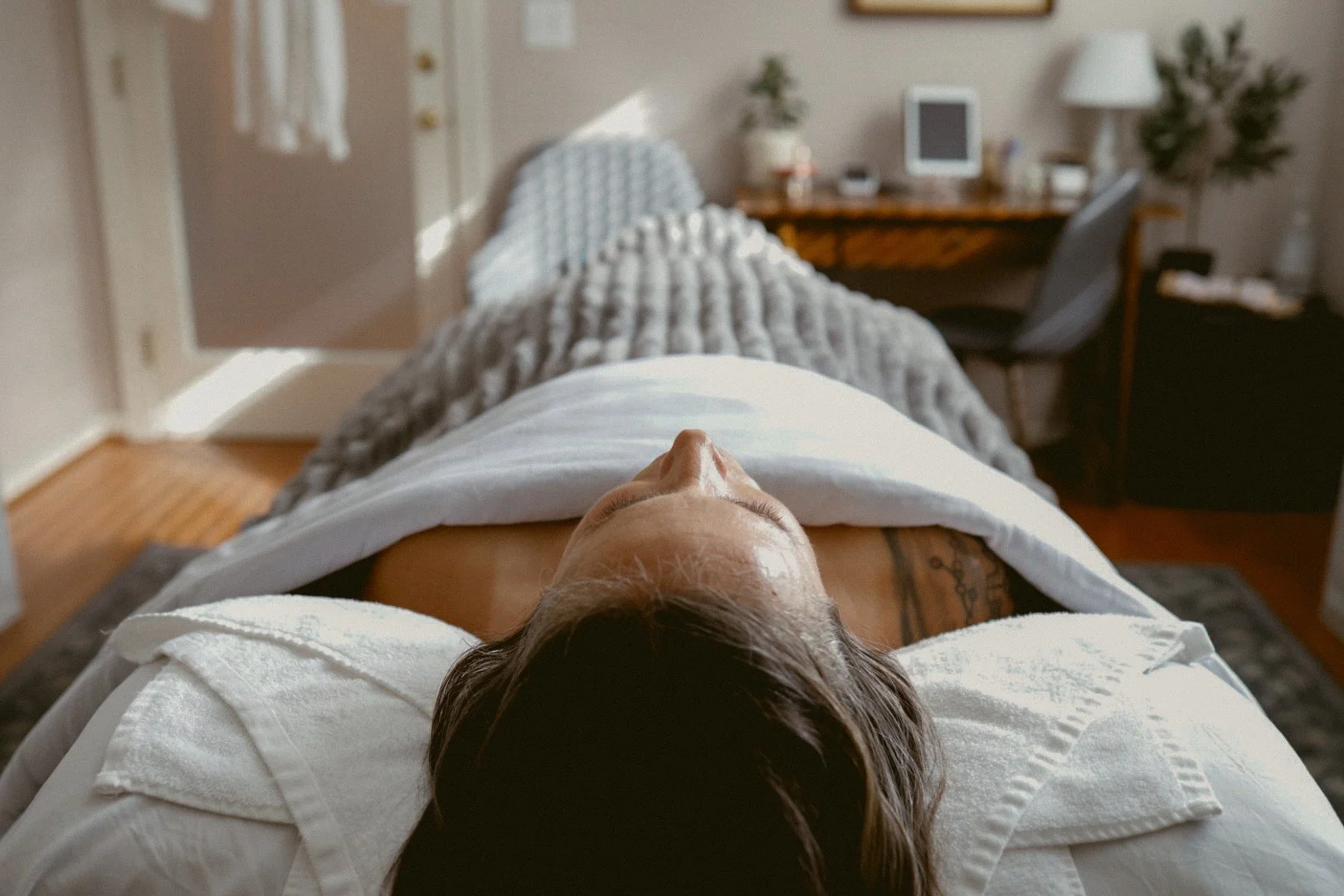
At The Tiny Spa, we often say that healing begins the moment you walk through our doors. While a massage or facial certainly isn't a substitute for a full night's sleep, it can be a beautiful reminder of what deep rest actually feels like.
Every service begins with a slow breath.
Every treatment room is intentionally quiet.
The lighting is softened, the pace slows, and your nervous system is gently invited to let go of the constant state of doing and return to simply being.
It's amazing what can happen when our bodies finally feel safe enough to rest.
The shoulders soften.
The jaw unclenches.
Breathing becomes deeper.
Thoughts become quieter.
Sometimes our guests even drift off to sleep on the treatment table, and honestly, I smile every time it happens. Not because they're sleeping through the massage or facial, but because their body has finally found a place where it feels safe enough to surrender.
In a world constantly asking us to move faster, achieve more, and stay connected, perhaps one of the greatest gifts we can offer ourselves is permission to slow down.
To breathe.
To be still.
To sleep.
Because the truth is, sleep isn't lazy.
Rest isn't unproductive.
They are some of the most important investments we can make in our future selves.
The woman I hope to be at eighty is being shaped by the choices I make at forty.
I hope she's strong enough to walk through gardens with her grandchildren.
I hope she still delights in traveling with her family.
I hope she can kneel down to pick flowers, rise back up with ease, and continue finding joy in the simple things.
And I have a feeling she'll look back with gratitude—not because I accomplished more—but because I finally learned to rest.
Perhaps the greatest luxury isn't buying something new.
Perhaps it's simply turning out the lights a little earlier tonight.
Tonight, I'll probably make myself a cup of herbal tea, curl up in the cozy reading chair tucked into the corner of our bedroom with a good book, take a few slow breaths, and remind myself that sleep isn't another task to accomplish.
It's a gift.
One that I'm still learning to receive.
Because every beautiful morning begins the night before.
In love & gratitude,
Jamie
P.S. As I was writing this essay, I kept thinking about something we witness almost every day at The Tiny Spa. Guests often fall asleep during their massage or facial—not because they're tired of the treatment, but because, for perhaps the first time in weeks, their body finally feels safe enough to rest. There is something incredibly beautiful about that. If you've been longing for deeper sleep, a quieter mind, or simply a moment to exhale, we'd love to hold that space for you. Sometimes healing begins with something as simple as closing your eyes, taking a deep breath, and allowing yourself to receive.